James Emory Mace
Brigadier General James Emory Mace (1940-2026), Nancy Mace's father: a Vietnam War hero and Distinguished Service Cross recipient, The Citadel's most decorated living graduate, and its Commandant of Cadets during his daughter's years as its first female cadet. He is the towering figure of her memoir and her public self-image.
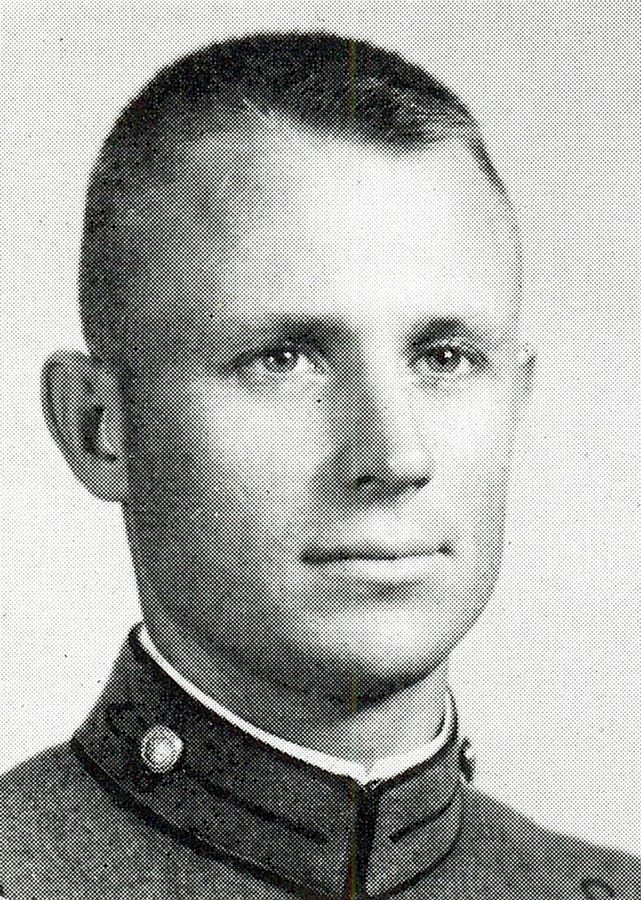
Brigadier General James Emory Mace (December 12, 1940 to April 14, 2026) was a decorated United States Army combat officer, a Vietnam War veteran awarded the Distinguished Service Cross, and the Commandant of Cadets at The Citadel from 1997 to 2005. He was the father of U.S. Representative Nancy Mace, and The Citadel calls him "the most decorated living graduate of The Citadel" (The Citadel; The Citadel Alumni Association).
He is on Maceopedia because he is the load-bearing figure of Nancy Mace's own story. In her 2001 memoir In the Company of Men: A Woman at The Citadel, she casts him as her hero, her standard, and the reason she followed him into the Corps of Cadets, where he was, at the same time, her Commandant. That relationship, her hero worship of him and her lifelong search for his approval, is a recurring theme she has returned to in her own words for a quarter century, from her 2001 memoir to a February 2026 Politico profile to the night he died. This entry gathers his documented biography and her own account of him. Everything here that touches that bond is in her own dated, public words: the page sets his record beside her telling of him, and lets readers weigh it.
Her hero, and the approval she chased for a lifetime
For a quarter century, in her own dated and public words, Nancy Mace has told one story about her father more often than any other: that he was her hero, that she followed him into the Corps of Cadets to earn a place beside him, and that his approval was the thing she wanted most and got least. It runs from the first pages of her 2001 memoir to a February 2026 magazine profile written weeks before he died, and on to her own account of the night he died. What follows is that throughline, beat by beat, in her words and in the words of the reporters and wire services who quoted her. These are her characterizations and theirs, not the site's; readers can weigh them.
The hero, and the distance. Mace introduces her father in worship:
"For as long as I can remember, my father has been my hero. I wanted nothing more than to prove that I was my father's daughter, to make him proud of me. I had little hope that would ever happen."
(Nancy Mace, In the Company of Men, 2001.)
On the same pages she sets the hero against a colder memory of her childhood:
"My father was gone much of the time and paid little attention to me when he was home. I sometimes wondered if he even loved me."
(In the Company of Men.)
Following him in. She writes that she chose The Citadel to stand where her father had stood, and to prove something to him:
"I could follow in my father's steps, become a cadet like he was, stand where he stood. This was my chance to prove to my father, to the kids in high school who had laughed at me, to myself, that I had what it took."
(In the Company of Men.)
When she told him she had applied, she writes, he tried for weeks to talk her out of it, and warned her that quitting would earn no rescue: "If you decide to quit, don't call me to come get you. Just put on your jogging shoes and start walking home." (In the Company of Men.)
When her father became her Commandant. Midway through her first year, Emory Mace was named Commandant of Cadets, placing her father at the top of her own chain of command. In her telling, he answered the closeness by erasing it:
"Once he became Commandant, I ceased to be his daughter while on campus. In his eyes, I was just another cadet, and the one time I walked into his office without an appointment, he threw me out in wrath."
(In the Company of Men.)
His coldness at her triumph. In 1999, Nancy Mace became the first woman to graduate from The Citadel's Corps of Cadets, and her father, as Commandant, handed her the diploma. Asked about her achievement that day, he told the Associated Press:
"She's done it all on her own with no help from daddy ... I would make an effort not to associate with her. You need to make it on your own and blend in."
(Associated Press, 1999, via CBS News.)
The adult bookend. Twenty-six years later, a reporter watched the same pattern play out. In a February 2026 Politico Magazine profile by Michael Kruse, Mace summed up the relationship in a single sentence, "My father has told me no most of my life," and, pressed on why she still sought his approval, allowed through tears that she did not feel "good enough." Kruse's framing was that Mace had found, in Donald Trump, what the profile called "the other fatherly figure": asked whether she sent her polling charts to her father, Mace said she had sent them instead to "the other fatherly figure," and named what she wanted back from him as "acknowledgment ... approval." That framing and those characterizations are Politico's and Michael Kruse's; Maceopedia reports them and does not adopt them.
The deathbed. The pattern held to the end. Emory Mace died on the night of April 14, 2026, about seven weeks after the profile ran. By her own account of his final minutes (told in full below), Nancy Mace was still holding up the proof of his heroism, reading aloud to him newly discovered testimony from the soldiers he had saved at Dong Xoai in 1968:
"As I read those words to him, he grew calm. And then he was gone."
(Rep. Nancy Mace, @RepNancyMace, the night of April 14, 2026.)
Every beat above is Mace's own, from her published memoir and her on-record interviews and posts across 2001 to 2026. Maceopedia draws no clinical conclusion and pins no label; it sets her words in order and leaves the reading to you.
"Poor but proud": early life in the lowcountry
Emory Mace was born in Hampton, South Carolina, in 1940. His mother, Iva Marie Mace (nee Thomas), served 42 years as the Hampton County Director of the Department of Social Services; a county building is named for her. His father, James Archibald Mace, was a lawyer and former Mayor of Hampton who later served as lead counsel for Santee Cooper during the building of Lakes Marion and Moultrie (The Citadel Alumni Association). As a teenager he worked summers digging ditches for the state highway department.
In In the Company of Men, Nancy Mace tells a harder, more mythic version of his origins that she was raised on:
"I grew up in the home of The Citadel's most decorated living graduate, Brigadier General Emory Mace. My father grew up 'poor but proud,' to use the local phrase. Dad was very young when my grandfather died, so from an early age my father and grandmother struggled to make ends meet in the low country of South Carolina."
"My dad has always said that it was The Citadel that changed his life. Among his other jobs, Dad drove the local school bus during high school to make ends meet. It was through this job that he met a Citadel graduate who took a liking to my father and wanted to help him ... he offered to sponsor Dad for admission to The Citadel."
(Nancy Mace, In the Company of Men, 2001.)
A discrepancy worth naming plainly: the memoir's rags origin does not square with the documented record. Nancy Mace writes that her father grew up poor, that her grandfather died when Emory was "very young," and that Emory and his grandmother "struggled to make ends meet." But public biographical and obituary sources describe Emory's father, James Archibald Mace, as a practicing lawyer and former Mayor of Hampton who served as lead counsel for Santee Cooper during the building of Lakes Marion and Moultrie, a long and established professional career, not a household left destitute. (Emory's mother's 42 years running Hampton County's social-services office are separately confirmed.) The tension is present within the family's own account: his funeral-home obituary pairs a narrative of "humble beginnings," down to 33-cents-an-hour summer labor for the highway department, with that same father's career as a practicing attorney, elected mayor, and utility counsel (J. Henry Stuhr). The rags-to-honor arc is the family's telling; the documented record describes a more settled, professional household. Readers can weigh the two.
Citadel cadet, Class of 1963: "Bulldog"
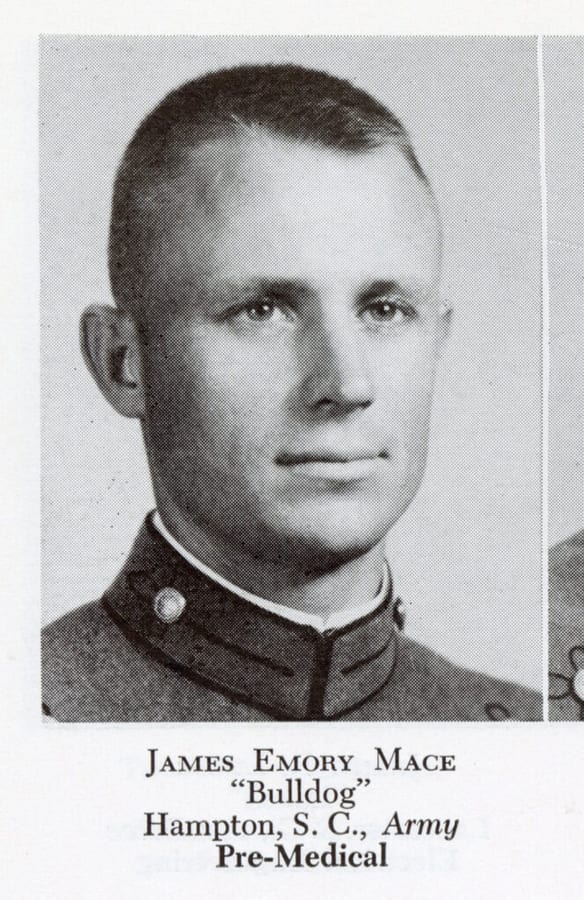
Cadet James Emory Mace, "Bulldog," of Hampton, S.C., in the 1963 Citadel yearbook (The Sphinx). Source: The Citadel.
Mace entered The Citadel and graduated in 1963, earning the cadet nickname "Bulldog" (Post and Courier). The legend of his cadet years, the stories his daughter says she grew up hearing, runs through her memoir:
"From the time I was a little girl, I heard stories of my father's college days. His scholarship and loans didn't begin to cover all his expenses, so to make up the deficit, my dad would go into the swamps near the Ashley River at night and poach alligators like he had as a boy. It was a dangerous but profitable business that paid his tuition for four years."
She recounts him chaining a live alligator to the parade field overnight to bewilder the officers the next morning, making his freshmen pluck the ducks he shot, and, as a senior, throwing a live alligator into the room of a "knob" who was not toeing the line. Her verdict on the man behind the tales: "Nobody messed with my dad." (In the Company of Men.)
Vietnam and the Distinguished Service Cross
Mace attended Ranger School and deployed to Vietnam twice: first as an advisor to a Republic of Vietnam airborne battalion in 1965 to 1966, and again as a rifle company commander and brigade operations officer with the 1st Air Cavalry Division in 1968 to 1969 (The Citadel Alumni Association).
For his actions over three days in December 1968 near Dong Xoai, he was awarded the Distinguished Service Cross, the U.S. Army's second-highest award for valor. The official citation (General Orders No. 838, Headquarters U.S. Army Vietnam, March 9, 1969) reads in part:
"Captain Mace distinguished himself by exceptionally valorous actions from 2 to 4 December 1968 while commanding his company on a search and clear mission near Dong Xoai. When his point element came under heavy fire, Captain Mace moved forward and directed his men in a flanking movement which forced the enemy to retreat from their bunkers ... Braving intense enemy fire, he organized a rescue party and led it from the night location to rescue the crew of an ammunition re-supply helicopter shot down by the communists ... After exposing himself to the vicious enemy fire to carry a wounded man to safety, Captain Mace stood up to spot the enemy gunners, personally killing two and wounding three of them. Finding that the foe was attempting to encircle his company, he ordered a withdrawal and remained behind to direct rocket artillery to within one hundred meters of his position ... Captain Mace's extraordinary heroism and devotion to duty were in keeping with the highest traditions of the military service."
(Full citation: Military Times Hall of Valor.)
In her memoir, his daughter wrote that this was the man she grew up beneath:
"The walls of our house were lined with medals for bravery in battle, and I knew my dad had risked his life over and over again to save his men in battle. For as long as I can remember, my father has been my hero."
His full list of decorations, as recorded by The Citadel Alumni Association: "the Distinguished Service Cross with V Device, the Distinguished Service Medal, the Silver Star, the Legion of Merit, the Bronze Star Medal with 'V' Device and four Oak Leaf Clusters (three for Valor), the Purple Heart, the Meritorious Service Medal and Oak Leaf Cluster, the Air Medal with two Oak Leaf Clusters, the Joint Service Commendation Medal, and the Army Commendation Medal with 'V' Device and three Oak Leaf Clusters." He wore the Ranger Tab, the Combat Infantryman Badge, and the Master Parachutist Badge, with more than 500 jumps.
His war record rests on official Army documents and stands uncontested. The Distinguished Service Cross is a matter of formal record (General Orders No. 838, Headquarters U.S. Army Vietnam, 1969) and is carried in the Military Times Hall of Valor register. Across the public record, the Citadel and government tributes, the valor registries, and the veteran and unit-history sources, no account questions or corrects his decorations or his conduct in combat. His heroism at Dong Xoai is one of the few things about the Mace family that has drawn only corroboration.
Army career and the Ranger Hall of Fame
Over a 28-year Army career, Mace served across the airborne and infantry force. Reporting to Fort Benning, Georgia, in 1985 as a special projects officer, he authored FM 7-85 (Ranger Unit Operations), the Army's field manual for Ranger operations. He completed his active duty as Chief of Staff, 4th U.S. Army, at Fort Sheridan, Illinois, retiring in 1991 (The Citadel Alumni Association).
In 2007 he was inducted into the U.S. Army Ranger Hall of Fame, the first graduate of The Citadel to receive that honor, recognized "for demonstrating extraordinary valor and unparalleled leadership throughout his active-duty Army career" (SC House Resolution 5552).
Commandant of Cadets, 1997 to 2005
Mace was appointed Commandant of Cadets at The Citadel in February 1997, months after the college admitted its first women, and he held the post through 2005, the longest tenure of any Commandant in the institution's history. He is credited with steadying the school through coeducation and with sweeping discipline reforms: prohibiting harassment during meals and study periods, eliminating sophomore rank authority over freshmen, banning physical contact with first-year cadets, limiting "knob knowledge" requirements, and shortening orientation. In 1997 the Corps adopted a new Citadel creed he wrote (Post and Courier):
"I will always endeavor to uphold the prestige, honor and high esprit de corps of The Citadel and the South Carolina Corps of Cadets ... Under no circumstances will I ever embarrass The Citadel and the South Carolina Corps of Cadets."
(The Citadel creed authored by Commandant Mace in 1997, as reproduced in the Congressional Record, April 16, 2026.)
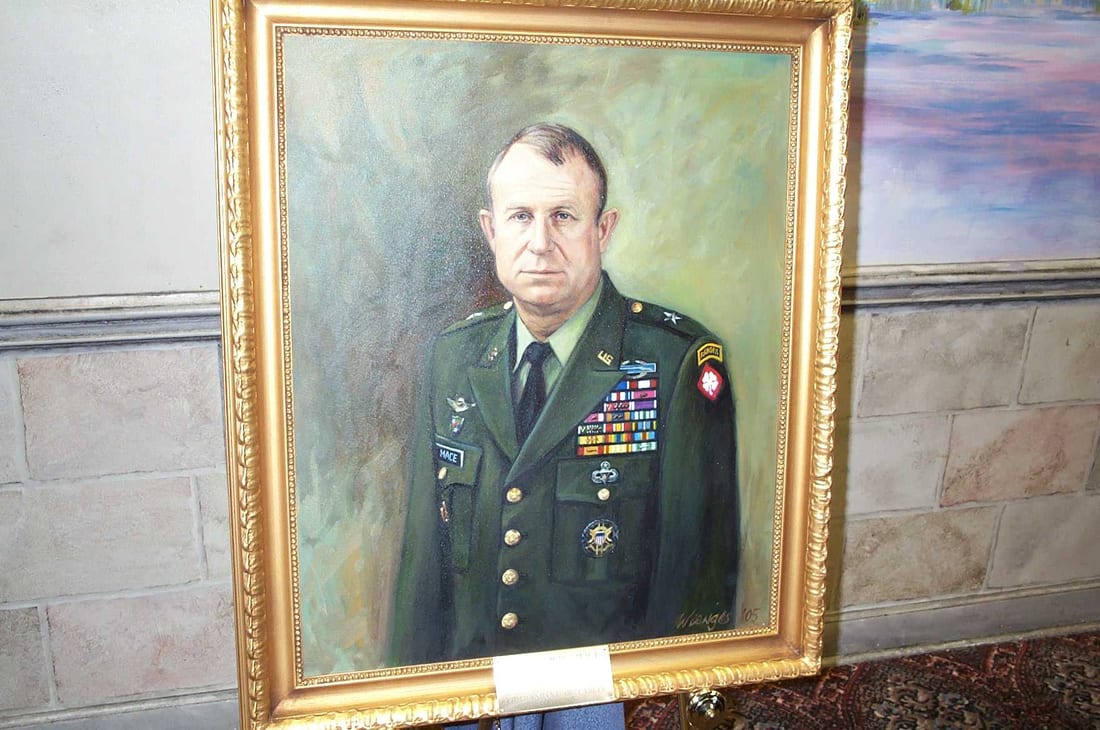
The official Commandant of Cadets portrait of Brig. Gen. J. Emory Mace, unveiled in 2005 and hung in The Citadel Library. Source: The Citadel Alumni Association (Class of 1963).
A public contradiction sat at the center of the appointment. The officer The Citadel chose to carry it through coeducation had opposed admitting women in the first place. "The wife and I were not pro-females going there," he told the Atlanta Journal-Constitution in 2009. The first woman to finish the Corps he now commanded would be his own daughter. On leaving the post in 2005, he said simply: "I feel I made a small difference in the life of The Citadel." (Post and Courier.) A South Carolina House and Senate concurrent resolution that year honored him as "one of the school's most highly decorated veterans" and "the longest-serving Commandant of Cadets in the history of The Citadel" (SC H. 4222, 2005).
The reforms, and the criticism they drew
The one real controversy of his Citadel tenure, distinct from his daughter, was over the reforms themselves. His appointment came in the immediate wake of scandal. Mace was named Commandant on February 11, 1997, weeks after two of the college's first women cadets, Kim Messer and Jeanie Mentavlos, left The Citadel following a hazing ordeal in the fall of 1996 in which, by their accounts, upperclassmen set their clothing alight. That scandal predated him; he was brought in as part of the college's reform response to it, not as the officer who presided over it. In the spring of 1997 The Citadel dismissed one male cadet and disciplined nine others over the hazing of Messer and Mentavlos (Feminist Majority Foundation). Mentavlos sued; The Citadel settled her suit for up to $135,000, the college itself paying $100,000, with no admission of liability (Feminist Majority Foundation), and in 2001 the U.S. Court of Appeals for the Fourth Circuit held that the individual cadets she had also sued were not state actors and so could not be held liable under federal civil-rights law (Mentavlos v. Anderson, 249 F.3d 301 (4th Cir. 2001)).
Taking the post, Mace drew a hard line on hazing. At his first cadet orientation as Commandant, in August 1997, he warned the incoming class:
"We will not tolerate hazing at this institution. If I find out about it, the hammer will fall, and it will be a pretty big hammer."
Of the freshman indoctrination period he added, "It's basic training, it's not Hell Week. We have decreased the tempo a bit" (Spokesman-Review, Aug. 26, 1997).
His remaking of the fourth-class (knob) system, the reforms described above, drew fire from traditionalists who read it as a softening of the college's defining ordeal. The Citadel acknowledges the backlash in its own institutional history:
"In 1997, Commandant of Cadets, Brigadier General Emory endured heavy criticism for instituting changes in the entire fourth class system. In his own words, General Mace, a '63 grad, looked to re-establish the type of system he and his classmates went through, one that was demanding yet refrained from violent hazing."
(The Citadel, "The Modern Period".)
Father of the first female Citadel graduate
Mace's Commandancy overlapped his daughter's cadetship. Nancy Mace entered the Corps in 1996, the year The Citadel first admitted women, and in 1999 she became the first woman to graduate from its Corps of Cadets. Her father, Commandant throughout her cadet years, handed her the diploma at graduation.
That milestone sharpened the contradiction noted above. The officer chosen to carry The Citadel through coeducation had opposed admitting women, and the first woman to complete the Corps he commanded was his own daughter, who says she entered it to follow him. How the closeness and the distance between them played out, in her own dated and public words, from the hero worship, to his cool "no help from daddy" on graduation day, to the "good enough" she was still chasing at 48, is set out in the section above, "Her hero, and the approval she chased for a lifetime." Her memoir and the Politico Magazine profile (Michael Kruse, Feb. 27, 2026) are the primary sources for that account.
Remembered by those who served with him
Beyond the official resolutions, the fuller measure of Emory Mace is in what the people around him said about him, in their own names: the soldiers who served with him, the cadets he commanded, and the friends who knew him. Much of it was set down in the public tributes left at his death.
A soldier who served with him across three assignments. One tribute came from a fellow soldier who had served beside Mace over years of Army life:
"My sincerest condolences on the passing of this hero. I served with Emory in the 82d, again in Panama and finally at Ft Benning in the Infantry Training Center. A great American, and a true gentleman. Not a bad hunter either. Rest in Peace SIR."
(Dick Helmling, obituary guestbook, via Post and Courier.)
The man they remembered. Another mourner drew the figure others recalled:
"They don't make men like that anymore. I remember him always with the end of a cigar in between his teeth. Tough, grit and a man you respected."
(The Steele family, obituary guestbook, via Post and Courier.)
A contemporary from his own cadet years wrote, "So sorry to hear of General Mace's death. He was a Citadel Cadet at the same time I was" (Joe Momier), and a friend from his later life added, "I got to know General Mace back around 2018 through mutual friends playing cards together every month ... General Mace will surely be missed by us all" (Chip Reeves), both left on the same obituary guestbook.
A cadet he commanded. Kevin Hazzard, Citadel Class of 1999, the class that graduated the first women and Mace's own daughter, remembered the Commandant addressing the Corps on Ring Night, gripping the podium with his voice breaking as he told the cadets what the ring meant to him and what he had done to keep it. In Hazzard's account, Mace's message was that the principles behind the ring "mean something only if the people wearing it carry them forward," and that "you don't get to choose your challenges, but you sure as hell get to choose how you deal with them" (The Citadel Magazine, "The First Class," 2019).
The testimony read at his deathbed. By Nancy Mace's own account, in his final minutes she read her father "testimony from his soldiers, words describing his heroism during December 2-4, 1968," which the family had "just discovered" from "the men who served beside him." That testimony has not been made public. Maceopedia notes its existence on her account and does not reproduce words it has not seen; what stands on the public record of those three days is the Army's own account, his Distinguished Service Cross citation, set out above.
Death and tributes
Live 5 News (WCSC, Charleston) reports the death of Brig. Gen. Emory Mace, April 2026. (Source: Live 5 News / WCSC, via YouTube.)
Emory Mace died at his home on the night of April 14, 2026, at the age of 85. In a long post on X that night, his daughter wrote that he passed at 9:56 p.m. as she read aloud to him newly discovered testimony from the soldiers who had served beside him at Dong Xoai in 1968:
"In his final moments I read him testimony from his soldiers, words describing his heroism during December 2-4, 1968, the acts that earned him the Distinguished Service Cross with Valor. We had just discovered new testimony from the men who served beside him. As I read those words to him, he grew calm. And then he was gone. He left this world knowing he was a war hero. Knowing he was loved. Knowing Jesus was waiting."
She wrote that he was "surrounded by his two dogs, his wife, and two of his daughters, Nancy and Mary," that days earlier she had "watched my father accept Christ as his Savior," and that he died on one of his grandsons' birthdays: "God doesn't do coincidences. He chose this day on purpose. A life celebrated as another began." She closed on the verse that would also end his obituary, 2 Timothy 4:7. The next morning she added a shorter farewell: "Rest in peace, Dad. I love you, and I'll see you again."
Tonight at 9:56 PM, my father went Home. In his final moments I read him testimony from his soldiers ... As I read those words to him, he grew calm. And then he was gone. He left this world knowing he was a war hero. Knowing he was loved. Knowing Jesus was waiting.
Rep. Nancy Mace (@RepNancyMace) April 15, 2026
Rep. Nancy Mace's post the night her father died, April 14 to 15, 2026.
His obituary closed with the verse he chose, 2 Timothy 4:7: "I have fought the good fight, I have finished the race, I have kept the faith" (The Citadel Alumni Association; arrangements by J. Henry Stuhr, Inc.).
Three days later, in a formal tribute, she tied her own life directly to his:
My father lived 85 extraordinary years on this earth. Everything I am, every ounce of fight in me, came from him. He taught me what it meant to love this country, to stand for something, and to never back down.
Rep. Nancy Mace (@RepNancyMace) April 17, 2026
Nancy Mace's formal tribute to her father, posted April 17, 2026. "Everything I am, every ounce of fight in me, came from him" is the same throughline she has drawn for 25 years, now in the past tense.
The funeral
The funeral was held Thursday, April 23, 2026, at 5:00 p.m. in Summerall Chapel at The Citadel, with interment immediately following at the college's Memorial Bell Tower Columbarium and a reception at Mark Clark Hall. The family invited the public and asked that memorial gifts go to The Citadel Class of 1963 Scholarship or to Roper Hospice (J. Henry Stuhr obituary).
We invite you to join us in celebrating the life of my father, Brigadier General (Ret.) James Emory Mace, Sr. Thursday, April 23, 2026. Funeral Service - 5:00 PM Summerall Chapel, The Citadel. Interment - The Memorial Bell Tower Columbarium, The Citadel.
Nancy Mace (@NancyMace) April 16, 2026
Nancy Mace's public funeral invitation, posted April 16, 2026.
Official tributes
The Citadel's president, Gen. Glenn Walters, USMC (Ret.), said Mace "was one of The Citadel's most decorated graduates who led our cadets and community through a period of tremendous change ... He was a model Citadel officer and he will be greatly missed" (The Citadel).
In the U.S. House, Rep. Joe Wilson (R-SC) honored Mace in the Congressional Record on April 16, 2026, calling him a "decorated Army Officer" and "the beloved father of Congresswoman Nancy Mace" and entering The Citadel's full obituary into the record. The tribute was submitted as an Extension of Remarks, entered in writing rather than delivered as a floor speech (Congressional Record, E337).
The South Carolina House of Representatives adopted a memorial resolution, H. 5552, on April 21, 2026, joined by more than 140 members. It recorded his valor at Dong Xoai, his 2007 Ranger Hall of Fame induction as "the first graduate of The Citadel to receive this honor," and his service as "the longest-serving commandant of The Citadel," and it named his survivors (SC H. 5552).
Survivors
Mace was married to Dr. Anne J. Mace for 61 years. The memorial resolution and his obituary name his four children: Elizabeth Anne Mace McGrath; Mary Frances Mace; U.S. Rep. Nancy Ruth Mace; and Col. James Emory Mace Jr., MD, U.S. Army. He was survived by 11 grandchildren and 6 great-grandchildren (SC H. 5552; J. Henry Stuhr obituary).
Coverage and tributes on the record
His death was reported across South Carolina and marked in real time on the public record. The state's own veterans agency published a tribute, and the Post and Courier framed his legacy around the coeducation transition he led:
Honoring the Life of BG (Ret.) James Emory Mace. A distinguished U.S. Army Ranger, Hampton County native, and Commandant of The Citadel from 1997 to 2005.
South Carolina Department of Veterans' Affairs (@4SCVETS) April 15, 2026
James Emory Mace, the father of Nancy Mace, was a decorated Army officer who led The Citadel through a dramatic transition from an all-male institution to a co-ed military college.
Post and Courier Columbia (@PCColumbia) April 15, 2026
The announcement was also carried by Holy City Sinner and, on the nationally syndicated wire, by ABC News 4 / WCIV.
Sources & related coverage
- Military Times Hall of Valor: James Emory Mace, Distinguished Service Cross citation
- The Citadel Alumni Association: obituary and full biography of BG (Ret.) J. Emory Mace, Sr. '63
- The Citadel Today: "Remembering Brig. Gen. James Emory Mace, former Commandant of Cadets"
- Post and Courier: profile of James Mace and his Citadel legacy
- CBS News / Associated Press (1999): "A Woman Storms The Citadel"
- Politico Magazine (Feb. 27, 2026): "'I Don't Know That I'll Ever Be OK With Myself'"
- Live 5 News (April 15, 2026): "Father of Nancy Mace, former commandant of cadets at The Citadel, dies" and the video report on YouTube
- Congressional Record, Extensions of Remarks E337 (April 16, 2026): Rep. Joe Wilson, "Recognizing Commandant James Emory Mace"
- J. Henry Stuhr, Inc.: funeral notice and obituary of BG (Ret.) James Emory Mace
- ABC News 4 / WCIV: "Rep. Nancy Mace announces death of father, Army Brig. Gen. James Emory Mace"
- South Carolina Department of Veterans' Affairs: "Decorated Veteran and Hampton native, BG (Ret.) Mace leaves enduring legacy"
- SC House Resolution 5552 (2026 memorial) and SC Concurrent Resolution H. 4222 (2005 retirement)
- The Citadel: "The Modern Period" (institutional history noting the "heavy criticism" of his fourth-class reforms)
- Spokesman-Review (Aug. 26, 1997): "Actually More Like 'Heck Week': Commandant At The Citadel Warns About Hazing As Women Begin Training"
- Feminist Majority Foundation: "Citadel Punishes Nine, Expels One for Hazing, Harassment" and "Female Cadet Settles Suit with Citadel"
- Mentavlos v. Anderson, 249 F.3d 301 (4th Cir. 2001) (Justia)
- The Citadel Magazine (2019): "The First Class"
- Post and Courier / Legacy: obituary and guestbook tributes for James Mace
- National Ranger Memorial Foundation: Ranger Hall of Fame inductees (BG James E. Mace Sr., 2007)
- Nancy Mace and Mary Jane Ross, In the Company of Men: A Woman at The Citadel (Simon and Schuster, 2001).